
One damaged panel can leave a warehouse door looking as though it needs a complete replacement. In some cases, however, replacing the affected section is a practical option. The decision depends on the door’s condition, the availability of a compatible panel and whether the complete installation can be returned to correct operation.
A recent Zenith Doors warehouse repair provides a useful example. Our engineers replaced one panel, squared up the surrounding sections and tested the door on completion. Here is what facilities managers should consider before choosing between a sectional door repair and a new installation.
A warehouse repair: replacing the fourth panel
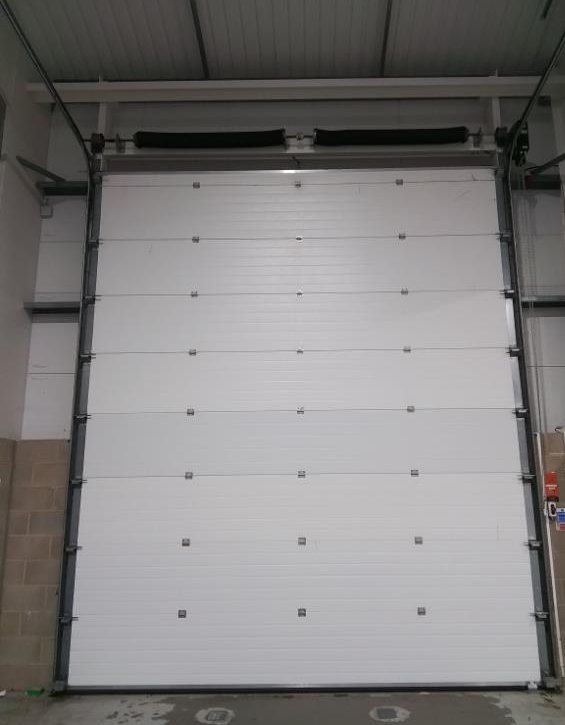
For this job, the recorded scope was to remove and replace the fourth panel up from floor level. The surrounding panels were then repositioned and squared up to achieve correct alignment and a uniform finish. Panel positioning and alignment were checked, and the door’s operation was tested and confirmed to be functioning correctly.
This was a targeted repair to an existing installation. The job record does not identify the cause of the panel damage, so it would be wrong to attribute it to a forklift impact or any other particular incident. It also does not establish that every door with similar-looking damage would be suitable for the same repair.
Why assess the whole door?
A sectional door is made up of connected panels that move together. Zenith’s sectional overhead doors open vertically and store the sections above the opening. That arrangement makes the relationship between neighbouring panels and the supporting mechanism important when assessing a repair.
The useful question is therefore broader than whether a dented panel can be removed. An engineer needs to establish whether a replacement will work with the existing door and whether other defects also need attention. A photograph is a helpful starting point, but it cannot establish the condition of every component.
Tell the engineer if the door has started moving unevenly, making an unfamiliar noise or stopping in a different position. These observations help define the inspection; they do not identify the cause on their own.
What makes a replacement panel suitable?
A replacement needs to be compatible with the existing installation. Ask the repair provider to confirm the door identification, panel configuration and relevant fittings before ordering. A panel that looks similar in a photograph is not sufficient evidence of compatibility.
Appearance also deserves an early discussion. Existing external finishes may have weathered, and an exact visual match should never be assumed. If the door faces a customer entrance or forms part of a prominent building elevation, explain how important the finish is when requesting a quotation.
For the warehouse job, the documented work included checking the surrounding panel alignment and uniformity of the finished arrangement. Those details are a reminder to agree the scope of the repair, rather than treating the new panel as an isolated purchase.
When might a complete replacement be considered?
A single-panel repair may be worth investigating when the issue is localised and a suitable replacement is available. A new door may deserve consideration when compatible parts cannot be sourced, several areas require substantial work or the existing installation no longer suits how the building is used.
Ask for a clear explanation of both options where they are realistic. A useful quotation should identify the proposed work, any further issues found during inspection and any assumptions about parts availability. There is no reliable universal price or percentage saving that applies to all sectional doors.
Changes to the opening, traffic patterns or access requirements may also affect the decision. Explain these before approving a repair so that the recommendation reflects the premises as they operate today.
Planning the visit around warehouse activity
When arranging an inspection, provide the door’s location within the building, its approximate size and any identification details that can be read safely. Share photographs of the whole opening and the affected area without opening covers or approaching a moving door.
Explain delivery schedules, vehicle routes and any restrictions on access. Agree how the work area will be kept clear and what alternative route is available while the door is being worked on. If the opening cannot be secured or the door appears unstable, make that clear when reporting the fault.
Testing and looking after the repaired door
In this example, the repair was followed by alignment checks and an operational test. Ask for a record of the work completed and any remaining recommendations at handover. Do not assume that changing one panel resolves every pre-existing issue elsewhere on the door.
The HSE’s guidance on powered doors and gates explains that maintenance is part of keeping these systems safe over time. Follow the instructions and maintenance arrangements relevant to your installation, and report changes in its behaviour. Leave adjustments to the lifting mechanism, tracks and powered equipment to a competent engineer.
Arrange a sectional door assessment
Zenith Doors supports commercial and industrial customers nationwide, with its head office in Devon. If a panel is damaged, our industrial door repair team can assess the installation and discuss an appropriate scope of work. Ongoing support is available through our maintenance services.
Call 01626 833016, email service@zenithdoors.co.uk or send Zenith an enquiry with details of the door and the problem.